
Saturday, April 26, 2008

Flavoring Your Summer Veggies, Right Now

Recently someone commented on an older posting of mine that some of last year's veggies seemed to have no flavor. I think my reply may be of general interest, so I thought I'd post it instead of just replying privately.

Hi Raqui,

The discolored bean leaves I would say are cold damaged. The plant should recover.

For veggies with flavor problems, hmm. The seed being old is ok and won't affect flavor. If it germinates, it's got all the goodies. :-)

Some varieties of veggie are bred for ripening at the same time, or being drought/cold/heat hardy, etc, rather than flavor. If you feel you were using a good variety, though, the next thing to look at is your soil diversity. Trace minerals account for a lot of the flavor, as well as nutrition, in food. It may be time to get a multi-mineral supplement such as greensand or some custom organic preparation, to enrich your soil.

Just like you can make bread with only flour, water, and salt, you can grow a lot of veggies with only NPK (nitrogen, phosphorus, potassium) but they'll be pretty wonder-bread bland!

One reason that composting is such a good idea is that you're returning minerals from the non-edible parts of the plant into your soil. We were putting our plants into the city compost bin and picking up free city compost until last summer. Then we realized we were swapping our huge peavines and tomato plants for grass clippings and who knows what. Wups! So now we have a leaf-shredder that we use to shred garden waste, and our own compost bin.

Labels: , , , ,

Monday, February 18, 2008

More Stir-Fry Spikes, and A Pleasant Surprise


The warm weather continues to draw up delicious flower stalks from my Asian greens. I harvested a large colander full of tsatsoi leaves and flower spikes, as well as spikes from my joi choi in the hydroponic fence planters. The choi in the ground-level planters is barely starting to form central buds, as it gets less sun.


I did a very nice stir-fry with some Trader Joe's gyoza (they have both chicken and veggie, btw) in garlic and ginger slices, then added some leftover red rice and red quinoa. I rinsed the stalks and made sure there was plenty of water on them, and put them on top to steam, covered. When they turned bright green, then started to deepen in color, I added the tsatsoi and choi leaves, also dampened, with a little extra water. Another 2 or 3 minutes of steaming and everything was done beautifully. The stalks are substantial, but not crunchy or mushy, and the leaves are still squeaky.


And now for the surprise-- ripe tomatoes! I pulled my poor dead Costulato Genovese tomato bush a couple of weeks ago, as a windstorm had blown off the floating row cover and it had gotten obviously frost-bitten. I harvested the tomatoes still on it, and brought them in to fry up green. After a couple of days, though, they were clearly ripening! So I left them alone to go at it, and they ripened up beautifully. I just had a couple last night over brown rice with yellow split-peas, with broccoli and soy sauce and cheese. Yum! A nice taste of summer from the garden, long before time.

Labels: , , , ,

Saturday, January 26, 2008

Winter Greens: Getting Spiky About Spring

Welcome, Weekend Herb Blogging readers!


Not only are winter greens easy and fun to grow, they like to surprise you now and then by deciding that Spring must be here. With all the recent (relatively) warmer rain, some of my asian stir-fry greens seem to have decided to Go For It and see about flowering. Hmm, can you spot the joi choi who is thinking it's Spring?


Fortunately for us, these flower spikes are not only quirkily charming, but are also a special, nutrient-packed treat. Eat flowers? Isn't that just for fancy salads and goat cheese? Nope! For instance, most of us have eaten this edible flower, broccoli!


Broccoli has many tasty cousins to enjoy. There's Italian broccoli raab, and a number of friendly flower spikes that often go by the name Chinese broccoli but which can be anything from flowering choi to various mustards. Here's some tsatsoi that has decided to reach for the sky.


Along with the cultivated greens, we have some tasty stir-frying options mixed among our cover crops. The early flower clusters of culinary seed mustard, such as this lovely example in my side tomato bed, can be snipped and added to other greens, or tossed daringly in a cream sauce over pasta. Yum!


It's not only little Ralphie's mom in Rabbit Hill, always making peavine soup, who can appreciate winter peas extravagant growth habits. The tender tops, not yet in flower, are delicious steamed or gently toss-cooked in light olive oil, with or without matchstick ginger and a little garlic.


Plant some extra peas to snip periodically for the table, or just snip bits here and there for a special treat-- not too much if you want a good crop of pea pods. I think I still have some slack left on the main pea-patch. Thinning them out a bit also helps prevent powdery mildew when the weather gets warmer, but it's not going to be warm enough for that for quite a while yet!


Sunday, January 13, 2008

Rain and Little Buddies

The recent rain has been bringing all kinds of things out in the garden, including our little buddies, the Western Spotted Salamanders.


The ginormous green thing is a standard garden hose. Yes, this is a teensy weensy salamander. We wondered if we still had a breeding population of these little cuties, and apparently we do! I've been laying down pavers with hollow places and bark under them, where they'll get light winter sun and acceptable summer shade, in the hopes of keeping our garden slugs down by natural means. I think it's working!


One of the adult salamanders, on a half-inch garden stake next to the garden hose. Blurry, but you can get an idea that it's about 4 inches long including tail. I've seen bigger and smaller ones in the past 3 years, as well as once an albino one-- adult, so it clearly found good places to hide.


Are there fewer slugs around? I'll put a cautious "maybe" on that. But every little bit counts, and I've always loved salamanders!

Labels: , , ,

Sunday, December 02, 2007

Easy Fall Greens via Hydroponics


Welcome, Weekend Herb Blogging readers. Doesn't that look scrumptious? A crisp, shiny rosette of tsa tsoi, a tangy Chinese green that makes excellent stir fry material.

The best part is that I'm getting these delicious winter greens with almost no work, and I won't be composting them or digging out the planters to refill them with dirt for a second crop. I also don't have to worry about scrubbing dirt out of my sink; a post-harvest rinse and I'm done. How can all this be? I'm growing them hydroponically!


A colorful head of forenschluss speckled lettuce, plus more tsa tsoi; I'd better start my next batch of seedlings, and harvest these beauties soon.

About a month ago I had an 'aha!' moment while cleaning up in the back yard. In an untidy pile were a bunch of 3-foot long self-watering planters, the long window-box type, sitting empty. They're very shallow, so they're only good for things with shallow roots. Another item that needed putting away for winter was a giant 2 cubic yard bag of perlite. It was purchased by accident when I wrote "perlite" instead of "vermiculite" on a shopping list for someone else. Wups. Perlite, though, is one of the better mediums for hydroponics. I knew that I still had a good-sized container of dry mix for hydroponics solution in my garden storage bench. A plan was born!


My favorite red mustard seedlings, about 2 weeks along, with assorted lettuces and some ruby chard. The brown is harmless algae-- my fault for watering the seedlings directly from the top once. Note the handy little water level gauge built into this planter.

Now why did I have hydroponic fertilizer mix around? Some long-time readers may recall that when I lived in San Jose in 2003 and 2004, I had very little usable yard space for gardening-- our rental's sunny space was white pebble landscaping. Undaunted, and because I'd always been meaning to learn this stuff, I went out and got some hydroponic units and grew marvelous cucumbers, tomatoes, squashes, and peppers hydroponically. I'd started out buying gallon jugs of nutrient solution to dilute, but soon realized I was paying a lot for what was mostly water, and that buying dry mix would be better. A tiny bit goes a LONG way, so I still had plenty left over.


My San Jose hydroponic garden in late April 2004. Imagine everything tripled in size about 6 weeks later!

The main cloud around this hydroponics silver lining is that I don't like using artificial nutrient mix. I want to try doing hydroponics on filtered compost tea-- it should work just as well as the mix, as long as I dust some greensand into the perlite for extra minerals. I'll try that in the spring, or next fall, now that I have a baseline to work from and compare.

Self-watering planters are a really excellent choice for lettuce and greens, as so much of the plant is dependent on abundant water to grow crisp and strong. Even if you don't try hydroponics, it's worth putting some lettuce or stir-fry greens into a self-watering planter and letting them party on. You'll usually see a noticeable improvment in growth vs typical ground soil conditions.

Labels: , , ,

Sunday, November 25, 2007

Garden Desktop: Full of Beans!

This week's Garden Desktop doesn't amount to a hill of beans. Well, actually, wait, it DOES. Several hills, in fact!


This past weekend I finally shucked the beans I had drying on a table out on our porch. There are big white and brown Painted Lady beans from the side yard. These did so well, and are so delicious, that I will grow them on ALL the carport pillars next year, rather than on just one. The hummingbirds love the half-white, half-red flowers, too.


The big pink/red and brown beans are Scarlet Runner beans, whose all-red flowers are so popular with the hummies that they fight over them! They are wonderful to create a shady arch or temporary patio cover. I've been thinking of pulling up a couple of the foot-square pavers on our back patio and planting Scarlet Runners there on arches, to make a little afternoon nap nook. I have to figure out first if it will shade the veggie garden beds, though. I don't want that!


The smaller rounder beans are the heirloom that I call Monte's Italian, the nth generation of those given to us by our photographer and diver friend Monte Smith. They hybridize readily, so this year we tried to be careful about growing them away from the other beans. Even so, we got a few crosses with the Scarlet Runners, as shown by some of the pink rounded beans, and possibly with the Painted Lady as well-- the beans are usually a creamy tan color with one to three small dark-brown streaks, and some of them are suspiciously paler, and more similar to the Painted Lady beans in color.


Last year's bean drying, didn't take a pic of this year's.

I saved bean seed earlier in the year, and made sure to save from long, well-formed, plump pods with a minimum of 5 beans per pod. I was usually able to save 2 or 3 seeds of a 6 or 7 pod bean. Last year I just shelled them all and picked out the plumpest beans, and then realized "doh!", I was only selecting for part of the story!

As always, feel free to use and share this Garden Desktop. It's okay to link and publish with a link back and/or attribution, and to use in print for personal or nonprofit use. There's a 1280 x 960 version for larger desktops too.

Labels: , ,

Saturday, October 27, 2007

Mustard Season

Just in time for Weekend Herb Blogging, hosted this week by the talented Pille, we celebrate the beginning of the fall and winter greens season with some heirloom lettuce and a great salad greens that is often overlooked: mustard!

The cool weather coming in is the best time for growing delicious green things for salads, sandwich layers, and garnishes. Our lettuces, which hid from the summer heat, are starting to peek out from where they self-seeded. In the meantime, we'll plant to make up the difference!

Pictured here, on top of some Early Girl tomatoes (which are ripening late, under floating row cover), are fresh leaves of Forenschluss and Cimmaron romaines, and a crinkly red mustard leaf.

Mustard is the great "sleeper green" of the instant gourmet and adventuresome home gardener. Leaf mustard, unlike mustard grown for seed or as a cover crop, has broad leaves that range from mildly zingy to mule-kick strong. The variety I chose, sheerly for robust good looks, is Red Giant, and falls somewhere between those two extremes. I find the leaves by themselves too strong, but they layer nicely between a couple of romaine leaves in a lunchtime sandwich. The zingy pick-me-up of mustard leaves can let one skip the prepared mustard or mayo, handy for a bag lunch brought to work.

If you can grow lettuce, you can grow leaf mustard. Look for it on racks of Botanical Interests gorgeous illustrated seed packets, where Giant Southern and Giant Red are prominently displayed, as well as Mizuna, a sawtooth-leaved oriental cooking mustard green. In your local Asian market, look for "Gai Choi". Mustards come in a gorgeous palatte of colors and textures, too. High Mowing's Organic mustards include the stunning Purple Osaka and their striking "Hotshot" mix.

I picked up six-pack sets of lettuces and mustards at our community garden's fall plant sale. Forenschluss, which means "Speckled Belly", is a beautiful variegated romaine with an upright, compact habit. The bronze tones of Cimmaron go very well with Forenschluss, so I've planted them in alternating rows in my garden.

Labels: , , ,

Thursday, October 18, 2007

Strawberry Woes: Compost to the Rescue


Most commercial strawberry growers rely on heavy applications of methyl bromide or similar fumigants to combat black root rot, an endemic problem for strawberries. New agricultural research shows that growing strawberries in compost medium can substitute for soil fumigation. Fumigants, in addition to their toxicity and negative effects on the soil ecosystem, are increasingly expensive. Many small-scale growers cannot afford fumigants, yet the poorer yields of associated with black root make going without it unaffordable as well.


Mesh tube bags, sold commercially under a variety of names, were filled with compost and set up with drip irrigation. The strawberry plants were set directly into the compost tubes, and did not pick up the black root from the infected soil. Yields were increased a whopping 16 to 32 times!


Photo courtesy of USDA


In a lovely example of synergy, not only does this represent a more natural and affordable method for strawberry culture, the method frees growers from the ubiquitous use of black plastic. Acres and acres of black plastic are used to mulch between rows in large-scale operations. The tube bags, sometimes called "socks" are available in a wide variety of materials, including natural materials such as cotton or burlap, and biodegradeable plastic meshes.


In the photo above, I've taken a wide shallow planter and used some landscape edging to add a second tier to it. Making a multi-level strawberry planter with compost in mesh tubes would be even easier. I could try adding strawberry plants in a compost mesh tube as a raised edging on my planter beds, or around the base of the beds on top of the chip mulch I use to suppress weeds. I'll have to try that!

Labels: , , ,

Wednesday, October 17, 2007

A is for Avoiding Arsenic

We're starting a new series, the "Garden ABC". I thought we'd begin with a little scary information about ways that arsenic could be getting into your garden. That may sound bizarre, but actually arsenic is dangerous at very minor levels. The amounts to which we're exposed, from sources as diverse as coal-fired electrical plants to pressure-treated lumber to municipal water to chicken dinners, add up rapidly. Arsenic is a potent carcinogen, as well as a direct poison. The Safe Water Act would have lowered municipal water levels of arsenic from 50 parts per billion to 10 ppb, but it was struck down by the current administration.


We hope that arsenic is not entering your garden through your water supply. If you suspect that it might be, you can request the Consumer Confidence Report on your water supply. The other way that arsenic can sneak into your garden is via commercial chicken manure.


Not Just Chicken Feed


Here in the USA, commercial chicken feed contains roxarsone, an organic (in the chemistry sense) arsenic compound that suppresses bacterial infections in the chickens' guts and makes them gain weight faster. Unfortunately studies are showing that it's secreted in the toxic, inorganic form. As one article so aptly put it, Food for Chickens, Poison for Man. It's banned in the EU and ought to be banned here.


The rate at which bacteria convert roxarsone to toxic arsenic has been widely underestimated until the recent publication of new evidence linking chicken litter and toxic arsenic. The chicken waste is pelletized and sold as fertilizer to commercial farmers. Chicken manure is also sold in dried or composted form at hardware and garden centers. Studies show that fields which are spread with this material are getting noticeable amounts of arsenic.


If you know folks who are giving you chicken manure, check to see if they're mixing their own 'scratch' feed from grains or using a pre-mixed feed that might have roxarsone. There are numerous suppliers of certified organic chicken feed and mash if one prefers a pre-mix.

Labels: , ,

Monday, October 15, 2007

Gardening as Environmental Stewardship

Take a little patch of earth and make it a garden. Even if you only grow one thing. Even if it's a hardscrabble piece of bare dirt along the side of a wall, or a pot on a balcony, or a milk carton in a windowsill. That's what I'd like you to come away with, today on Blog Action Day, when we are all talking about the environment. Because WE are an integral part of the environment. Our human actions.


Being involved with maintaining the life of plants will involve you more intimately with the life of the planet. Even better if it's a plant you can eat, because you won't want to eat poison and you'll be more careful about what you use to keep other things from eating that plant.


We started our garden when we moved in, in February 2005. The ground was baked, cracked clay, utterly bare, without even weeds. The previous owner had torn out the dead sod, the lawn that nobody had watered while the place was for sale before he'd bought it. For three and a half years, he never got around to putting in a lawn, a garden, even any ground cover. So the bare ground sat and baked. No worms, no bugs, nothing.


After almost 3 years of hauling in compost, planting, putting down wood chips, letting things go to seed and spread, we now have a little ecosystem all our own. Every year we see new critters not previously encountered. Some of these new neighbors are not so great, like plant-damaging soldier bugs. Others are unexpected delights, like the giant salamanders, the little lizard I saw drinking from a soaker hose, and of course the hummingbird regulars who now understand that peas or beans will be flowering here most of the year (and that our neighbor's hummie feeder will take care of the wintertime).


We've gone from seeing a few bees here or there to hosting a wide array of pollinators: honeybees, to be sure, but also big black carpenter bees, ground-nesting bumblebees, and sleek metallic hoverflies. And we're still learning.


This year we're putting in mustard and vetch as a cover crop on some of the beds, with fall-winter fava beans. We've established alyssum that self-seeds, and cornflowers, and borage, along with plantings of lavender, to try to provide a year-round supermarket for our native pollinators.


We realized that even after just a couple of years, things don't grow so spectacularly as they once did-- we've been putting our virgin clay soil-grown, mineral-rich, organic tomato and bean vines in the city compost bin and getting back lawn-clipping gruel, even if it IS composted. Every eggshell that we've thrown in the trash is a bit of calcium that could have been useful in the garden. I have a few dozen eggshells, crushed into the bottom of a clean milk jug, drying, waiting to go into the garden now. The top of the gallon milk jug is a warming cap for a broccoli plant, and will nurture pepper seedlings this spring.


This fall we bought a lightweight 'leaf shredder' that uses a modified weed-whacker in a big funnel, and we shredded up our plants at the end of summer and mulched them into the beds. I could bang my head on the wall thinking of the cubic yards of tomato plant, squash vine, bean plants, etc that we've stuffed into the city 'yard waste' bin and sent away, but at least we're doing it differently now.


It starts with just a little patch of ground, even a single plant. If you do nothing else for the environment this year, plant a garden. You'll find out that it was really for you, too.


Yes, these are all photos from our backyard. The one below is what it looked like in November 2005. We've come a long way, baby!


Labels: , , ,

Friday, September 28, 2007

Full Circle Farm Groundbreaking

Sunnyvale city officials joined board members from the Santa Clara Unified School District and the Sunnyvale Sustainable Gardens non-profit in planting the first fruit tree, a plum, at the ground-breaking ceremony for Full Circle Farm. The farm returns 11 acres of unused land at the Peterson School to agricultural use as a not-for-profit farm and education center that will supply produce to the school district and local charities, as well as sell directly to the public.


Shovels stand ready for the true 'ground-breaking', digging a hole and planting the first of a small orchard of fruit trees that will echo Santa Clara's agricultural heritage and provide fruit for the Farm's school lunch and market garden programs.


video

A sizeable crowd turned out for the afternoon's festivities, which included informative displays about Santa Clara farming history, conservation strategies related to agriculture, the concept of 'peak oil', efforts to reclaim the former UC/USDA farm station in San Jose before it is developed and lost, and face-painting and rock-painting for children.


All of the tables were decorated with winter vegetable seedlings, planted in colorful pots that had been painted by children at last weekend's Santa Clara Art and Wine Festival. Visitors were encouraged to take a seedling or two home with them. I chose Italian parsley, as my pot of it was accidentally left unwatered sometime this summer.


The collection of local dignitaries paused for a photo op with the commemorative plaque that will mark the tree. I hope to edit this shortly to include names and affiliations-- please leave a comment if you can help identify people!


For even more pictures, see my
Full Circle Farm Groundbreaking set on FlickR
.

Labels: , , ,

Sunday, September 23, 2007

Winter Squash Pantry


This year I'm proudly displaying our winter squash as they cure, rather than lining them up along the wall or countertop as clutter. Our printer stand makes a great little pantry for the squashes. Yes, that's a face on one of them. I offered to decorate some pumpkins for someone on Craigslist, and did a sample on a handy squash!


The two squashes in the foreground are both interesting. The big one is part kabocha, and I believe part banana squash. It was saved from a kabocha I bought in a farmer's market. There is a typical-looking small kabocha ripening outside from the same vines, and it is the same lovely gray-green as the very tip of this squash.


Right at that tip you'll see a tiny ridged squash. That is a Black Futsu, a Japanese squash with an unbelievably intense flavor. It starts out a green so dark that it almost looks black (hence the name), and then turns a dusty orange in storage. The parent squash was also small, but at least double the size of this one. There's another tiny one on the vine outside. I hope that they're edible-- one reason they could be so tiny would be that they crossed with some kind of gourd.


I'm starting to think that, while seed saving from the farmer's market is fun, I might want to plant more 'official' seeds next year and get a more consistent harvest. Since I don't have room for more than a couple of plants of any large cultivars, like squashes, a packet of seed lasts me several years and is a good investment. Ironically, I have an unopened packet of Black Futsu that I didn't plant, preferring to use the saved seed instead (as this packet is vacuum sealed).

Labels: , ,

Sunday, September 16, 2007

Garden Wrap-Up

This is the time of year when we take apart the garden and put it back together for winter gardening. We were so busy doing that, and getting sticky and dirty with sap, compost, mud, etc, that we forgot to take pictures! So I did catch-up pictures of the items left over, minus a couple of big stir-frys. This is the time of year when we have the funkiest-looking veggies, as we clear everything off the plant when we take it out of the garden.


As usual, we got a lovely return on our beans. I think beans are one of the great gifts to gardeners. I plant a couple of dozen beans of various types and harvest a quart of dried beans, plus eating several meals of fresh young whole beans. The plants themselves are great nitrogen fixers, and can be shredded and mulched in place on the garden beds at the end of the season, or composted.


This year we added Painted Lady to the runner bean collection, growing it separately on a carport support. The plants quickly climbed up to the roof, and were claimed delightedly by a couple of the local hummingbirds. The Painted Lady beans are white with black squiggles, in contrast to the pink and black Scarlet Runner beans. I've picked out a batch for next year's planting (and for sharing!), from the longest and best-formed pods. Here the harvested beans are drying a bit more on the shelf, along with previously harvested peppers.


Our melon experiments were much more successful this year than last. We also discovered that a local squirrel or rat likes melons (grr!). Despite losing a couple of melons, our mini-melons did very well in the self-watering planters. We got a couple of tiny yellow watermelons, some mini-charentais, and a couple of a variety I've forgotten. I think all of these were supposed to be larger. I don't know if our soil wasn't amended richly enough, or if the cold snaps in the summer did it. I skipped the usual midsummer composting, being away, and I feel that was a big mistake.


Yes, we're being cute here. Still, we find cardboard egg cartons to be a good place to store veggies that we don't like to refrigerate. They allow good air circulation and are handy. I'm thinking of finding some small wire baskets on drawer gliders and hanging them under my kitchen cabinets over the countertop, which would be less cluttery than the egg cartons, and would be safe from countertop spills. There were several Ichiban long purple eggplants in this carton, too, but they went into the frypan before the picture was taken. Really like the Ichiban and the Fairy Tale (shown here) for tenderness and no trace of bitterness.


I've left our big Early Girl tomato plant alone, but the Green Zebra is history, as is the Pineapple Beefsteak and the Persimmon, so we have plenty of green tomatoes ripening up. The startlingly dark one is the Purple Russian; they never got more than a pale pink outside before something four-footed harvested them, or we did in self-defense. I had great hopes for a complex, smoky flavor in this, as is supposed to be true of many black or dark tomatoes, but I found it actually rather bland. Purple Russian tomato won't be returning to my garden next year. I'll try Black Krim or Black Prince, and rig netting so that I'll have a chance of ripening them on the vine.


When you're picking green tomatoes for later ripening, especially if you're pulling out the plant, take a good chunk of stem along with them. The ripening tomatoes will pull sugars from the stem, which slowly withers and hardens. The resulting tomatoes are almost as sweet as vine-ripened, certainly far and away better than supermarket tomatoes, even hothouse ones.


Our plans for a bountiful potato harvest were dashed by the construction of new fence between our property and the neighbors' in the back, as we didn't find out it was coming in until the workmen were already there. They dug out my potato patch to put in a posthole, and I was only able to salvage the area where I'd laid down the standing plants straight out from the fence and covered them with dirt for an extended harvest. That led to a nice batch of small new potatoes, about half of which are pictured here. They were delicious! They are mostly Russian Banana, with a few Russets here and there.


A few larger potatoes survived the shovels of the fence-builders. They'll be chowder someday soon!

Labels: , , , ,

Monday, September 10, 2007

Days of Squash and Roses

Summer is clearly coming to a close here in Silicon Valley. Breezy days in the high 70's wind down to chilly evenings and cool nights. I've got floating row cover over our peppers already and one of the eggplant beds.


Our roses are blooming again after a severe pruning in early August. The ultra-hot weather didn't do them any favors, even though I cut back on watering them to try to stave off any mildew or fungus problems. I'm participating in the Apartment Therapy 8-Week Cure, and one of the first things that comes up is to bring in fresh flowers. OK, they say 'buy', but I can just go out front right now, so I did.


Normally I'd have cut dahlias, but mine, alas, were just destroyed this past weekend by workers putting in a fence replacement. They might come back for the season or they might not-- they were completely uprooted. I reburied them and watered; worst case, they die back for this season. I'm planning on moving them this winter anyway. Still, there were a LOT of blooms left, and I'm sad about that.


What I think will be the last of my squashes are in now; I planted the ebicata kabocha too late, and it got hit with powdery mildew during our hot spell and hasn't set fruit yet. Too bad! But the red kuri / kabocha cross came through very well, and I may get another straggler from my Waltham butternut.


When the nights get cold, the squashes toughen up and get ready to pick. If you still have some ripening, be sure to gently lift them off the ground and make sure they're clear of little pillbugs or other critters trying to eat into the rind. Use a piece of old potshard or a tile to get them off the ground, or even rest them on the vine itself. There are two primary signs to look for in squashes. The first is that the stems will start to get hard, and may turn tan or shrivel up. Butternuts typically need a pair of bolt cutters to snip off the vine! The other sign is that the skin hardens to the point where it is difficult to mark it with a fingernail. Store fresh-picked squashes on a screened porch or on an open, well-ventilated shelf for at least a week or two to let them shed excess moisture. I keep mine on an open shelf as decoration, and gradually use them up in winter.


If you haven't grown your own squash, don't worry-- the ones at the Farmer's Market are perfectly lovely. Buy them now, when the markets are fairly swimming in them, and store them yourself at home for later. Don't wash them, but if they're dirty or mucky, you can polish them off with a barely damp cloth. Treat as you would your own fresh-picked, and let them cure a while before putting in a cupboard.


The rest of the garden is still busy turning out, as Mike's late grandmother would say, "a bissel of this, and a bissel of that". A friend of ours came over and we responded to the plethora of ingredients by making ratatouille, a perfect solution to lots of ingredients in quantities too small to make any one of them the centerpiece. OK, there are always huge quantities of zucchini; we balance them off against the rest of the ingredients that way!

Labels: , , ,

Harvest Snapshot: Sept 10


September harvests usually end up to be something of a mish-mash, and this one is no exception. Fortunately, the best veggie stir-fry has lots of different kinds of veggies, and we're definitely getting good material for that!


Time to round up the winter squashes and bring them inside. Make sure there's plenty of airflow where you store them, and let them 'cure' for a bit in the open air before putting them into a cupboard. Butternut squashes may drip slightly from the stem for a day before settling in, so make sure they won't drip on another squash.

Labels: ,

Friday, August 24, 2007

Harvest Snapshot: Aug 24


Garden volunteers make up a nice part of this harvest. The colander of yellow cherry tomatoes comes from self-seeded plants along our side yard. We moved some dirt around last fall, and apparently it had some tomato seeds in it. The pak choi was a straggler from a planter that had been harvested previously and was dumped in the side yard to help build up the soil layer there. I was very surprised to see it during the hot-weather season, but suspect its location in the fence shade is why it survived so well.


Zucchini and beans continue in mass quantities, often going straight into the freezer or the saute pan from the garden.

Labels: , ,

Friday, August 17, 2007

Harvest Snapshot: Aug 17


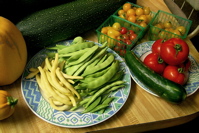
The usual beans and zucchini, and the beginnings of pepper season. Our particular picoclimate gets pretty chilly at night, so our peppers take longer to mature. Near the top left you'll see some tiny purple bell peppers, and in there's a long very dark green pasillo baijia chili at the very front of the tray. That's a mild to medium chili used in making mole; it dries to a rich chocolate brown, and is supposed to have a complex flavor of which 'hot' is only a part. This is the first year I've grown them.


Another pepper experiment is in the lower left, the small round 'Alma' variety paprika pepper. Supposedly both spicy and fruity, Alma is a very pretty plant, with creamy white peppers that ripen to yellow and then to a deep orange-red. I have this one drying on the bookcase right now, along with the pasillo. It's turned a deep wrinkly red.

Labels: , , , , ,

Sunday, August 12, 2007

Garden Desktop: Delicate Harvest


Today's garden desktop celebrates some of the finer things in garden life-- delicate strawberries, a baby fancy bi-color squash, and the aptly-named "Fairy Tale" eggplant. Enjoy!


Higher-resolution versions available by request, leave a comment here if the one at FlickR isn't large enough for your desktop. I've stopped posting the 1080 versions by default.

Labels: ,

August 12 Harvest Snapshot


Dry bean season is here, partly from the time of year and partly because I stopped picking young beans a week or so ago, to let pods mature for dry ones. These are the heirloom I call "Monte's Italian", given to me in 2003 by a friend from the photo club. He got them from his family in Italy. This year they returned true to type, as my back-fence neighbor Jack didn't plant beans, so no cross-pollination occurred.


The larger harvest is, of course, dominated by zucchini. Good thing we pick them small... when they don't get away from us. Just a single day can make a (literally) huge difference in the life of a zucchini. I grow the "Mediterranean" zucchini from Renee's seeds. I believe it's a French or Italian courgette variety, as it is ridged rather than smooth. The best thing about this variety is that it has a wonderful flavor when small AND still has a very good flavor and texture when large. Even very, very, VERY large. The generic dark green or black zukes one finds in the seedling section of the hardware store have very little flavor, even when tiny, and become appallingly bland and watery when they get huge.

Labels:

Tuesday, August 07, 2007

August 7 Harvest Snapshot

Labels:

Saturday, July 28, 2007

Garden Desktop: Dahlias


There's nothing like dahlias for summer bouquets. Long-lasting, intensely colorful, and in a variety of shapes and sizes. Best of all, they're easy-care perennials that will come back for you year after year!

Labels: , ,

Thursday, July 26, 2007

July 26 Harvest Snapshot

Labels:

Monday, July 23, 2007

Harvest Snapshot: July 22nd

A wonderful assortment of veggies greeted me upon my return. No strawberries in this picture, as I wandered through the garden munching them. We lost a few to overripeness, but most were cheerfully ready for a garden snack. A number of zucchini came and left while I was on vacation, faithfully transported into the office or eaten outright by my darling hubby, Mike.


Flowers abounded, as my dahlias burst into bloom during early July, and have been going strong ever since.


The summer squash that I planted too early, and which were shocked by cold, are now starting to tenatively offer up flowers, and even a squash or two. The small white patty pan squash and the two-color yellow-green summer squash are, I hope, the first of many.


Some of the cherry tomatoes were splitting from a daytime watering (wups!) but they all went promptly into the freezer, making a nice flat quart bag. Ditto with the non-cherry ones, which needed halving or quartering and went into a separate container. I like to freeze them flat, for quick freezing and thawing, and also in the right quantity for most of my cooking, which is for only two folks, me and Mike.


I was really shocked at how much change can happen in only a couple of weeks, though, when those weeks are in July and the hot-weather plants kick into high gear. Wow! Bush beans that had barely come over the top of a six-inch (15 - 20 cm) support mesh are now two feet tall and covered in flowers. Their counterparts planted two weeks previously rewarded me with a big double handful of beans, shown here.


Vining beans, such as my 2nd crop of Runners and my Chinese Noodle beans, had just come up and reached barely knee-high when I left on July 8th. The same plants today are over my head, nine and six feet tall (3 and 2 meters) respectively. The second planting of maize corn was similar height, knee-high, and has now doubled in size, while the first planting has sprouted ears in many places. One, as you can see in the picture, was ready to pick!

Labels:

Monday, July 16, 2007

A Visit to Eugene, Oregon

I didn't take many pictures on my trip to Seattle and to Eugene, as I was in 'real life' mode, and not really being a spectator. I also spent most of my time hanging out with folks, rather than touring public gardens. Well, next time! But I had a great time, and wanted to share a few garden-related pix with y'all.


Gray's Nursery was breathtakingly blooming with walls of hanging petunias and spectacular frontage plantings. I had to go in and tell the manager that I'd never seen such a gorgeous display outside of National Parks! I also wish I'd had a wide-angle lens to truly convey the splendour of it all. I stood in the parking lot (out of traffic, of course) for a long time looking at the huge walls of color.


I tried a number of different exposures and angles to try to get a nice desktop-type shot of the petunias, but it was mid-afternoon and brightly sunny. At last, a petunia desktop, which currently adorns my laptop, and is here to brighten your day at work.


I was completely impressed by the numbers and varieties of huge trees on the streets here. Most were types I recognized, but some, like this one, are unfamiliar. Is this a chestnut? Or are those some kind of persimmon? If you know what this is, please let me know.


While a truly iconic Eugene street scene would feature bicycles, I couldn't resist snapping this adorable classic Vespa scooter, parked on a curving curb between two great cafe